CGM in Type 2: Small Number, Big Picture
Sep 27, 2026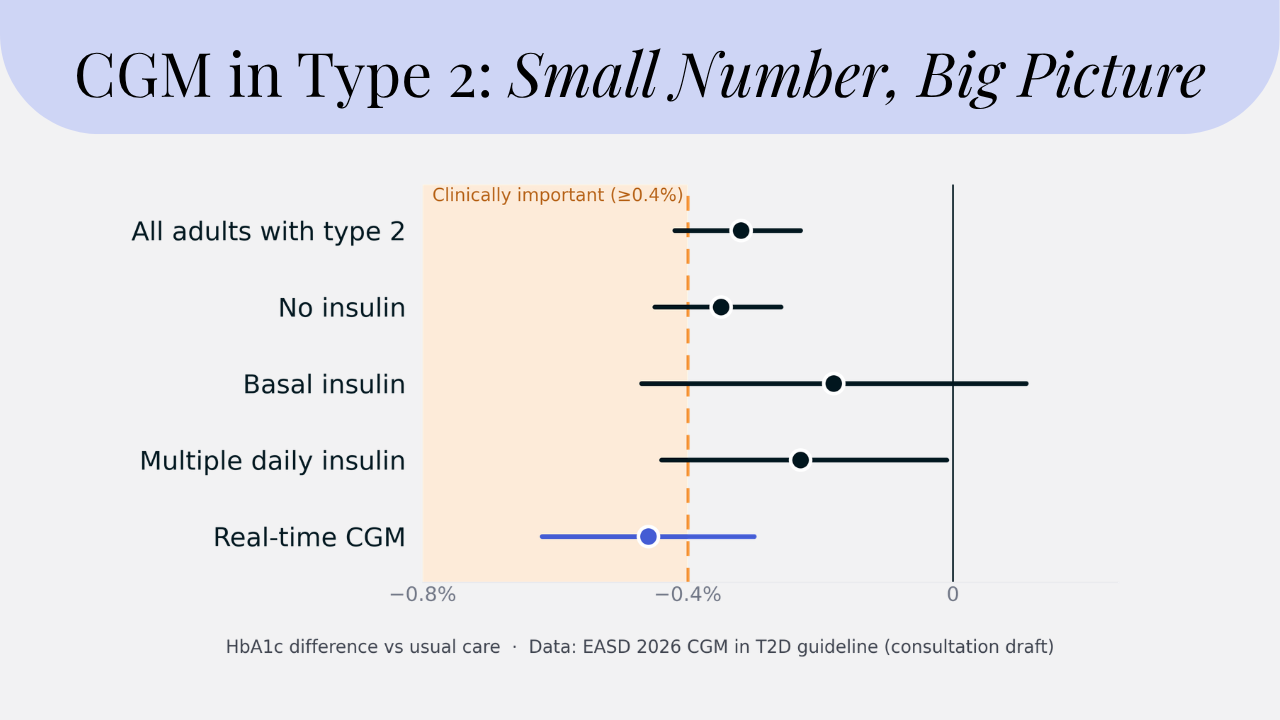
What the new EASD guideline on CGM in type 2 diabetes really shows
Today the EASD Annual Meeting opens.
With it comes the first EASD guideline on continuous glucose monitoring (CGM) in type 2 diabetes [1].
The draft was open for public consultation this summer, together with its technical report and evidence tables [2].
That is the version I discuss here.
My first reaction was surprise.
The effect looked smaller than I expected.
This blog is my attempt to understand why — and to make sure the results are read in the right context.
A small average is not the same as a small effect. But it isn’t a large one either.
In short
- The EASD suggests offering CGM to all adults with type 2 diabetes, whatever their treatment.
- In randomised trials, CGM lowered HbA1c by 0.3% on average. That is real, but below the 0.4% the panel set as clinically important. Certainty of the evidence is low.
- The pooled trials include masked CGM and older sensors. Real-time CGM alone reached −0.46%. Newer trials with current sensors show −0.4% to −0.9%.
- Benefits go beyond HbA1c: more time in range, higher treatment satisfaction, and — in real-world data — fewer acute hospital admissions.
- The biggest gap is not the sensor. It is that too many people are never offered one.
What the guideline says
The panel asked one question, nine times: should CGM added to usual care be offered, instead of usual care without CGM?
- They asked it for everyone with type 2 diabetes,
- for each treatment group,
- for each type of CGM,
- and for continuous versus periodic use.
They pooled 48 randomised trials with 5,749 adults.
Average HbA1c at the start was 8.7%.
Most trials lasted about six months.
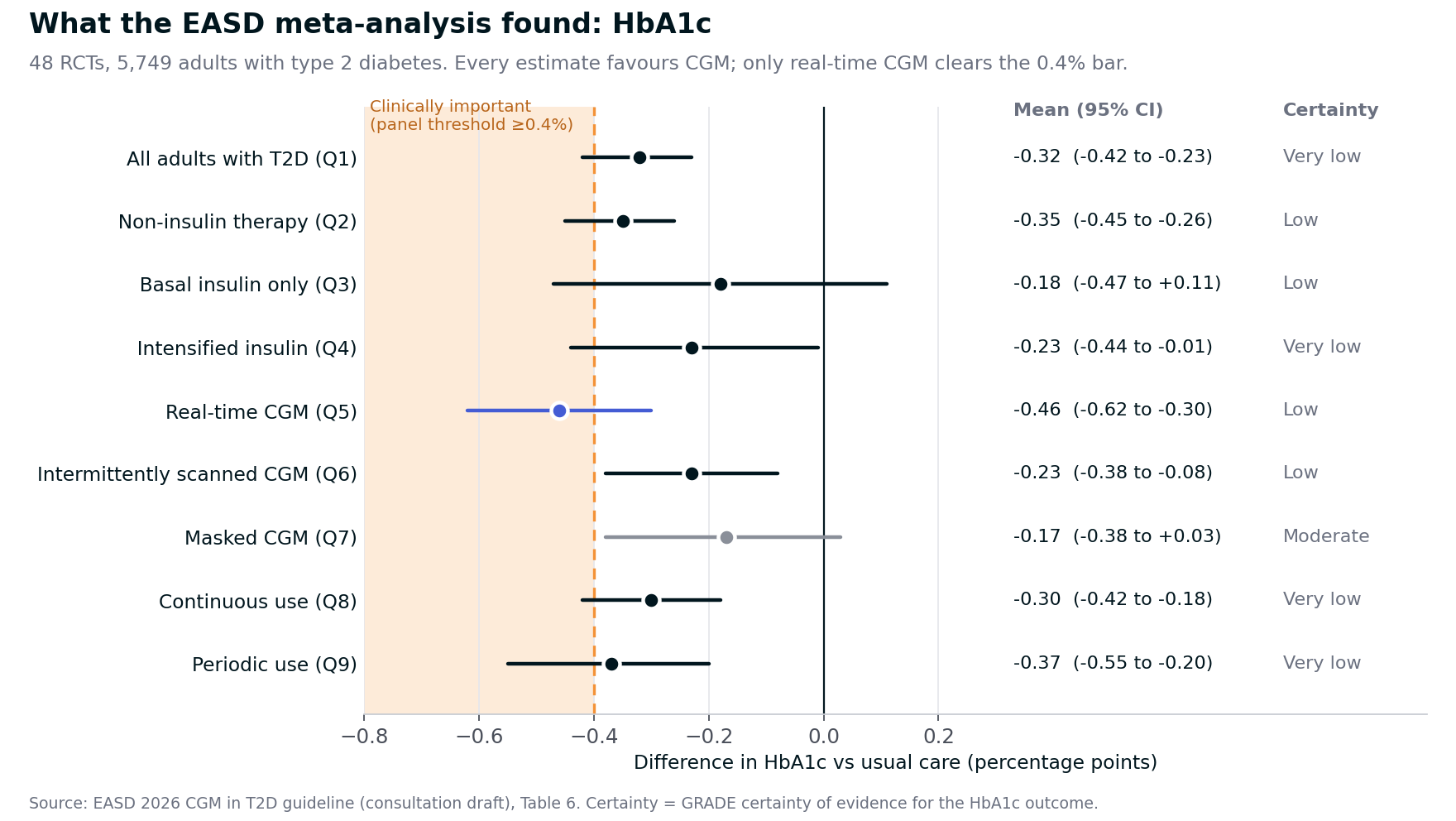
Figure 1. HbA1c difference versus usual care for each of the nine clinical questions. Source: EASD 2026 draft, Table 6.
Overall, CGM lowered HbA1c by 0.32 percentage points.
Every estimate points in the same direction. Only real-time CGM crossed the 0.4% threshold.
Beyond HbA1c:
- Time in range rose by 6.3 percentage points — about 1.5 hours more per day.
- Treatment satisfaction improved.
- No clear difference in hypoglycaemia, quality of life, diabetes distress or weight.
- About 5% of users had a skin reaction.
Two things worth understanding
What does 0.3% mean? The panel decided in advance that 0.4% was the smallest clinically important change. They chose it as a midpoint between 0.3% — a margin often used by regulators — and 0.5%, the traditional threshold for a meaningful treatment effect [1]. So 0.3% is not nothing. It sits just below a line the panel drew itself.
What does “we suggest” mean? In the GRADE method, a conditional recommendation means: the benefits probably outweigh the downsides, but there is uncertainty. Most people would want it; some would not. The decision is made together with the person with diabetes.
That is not a “no”. For every group of adults with type 2 diabetes, the answer was yes, offer it. Only masked CGM — where the person never sees their own values — was not suggested for routine care.
The direction is clear. The size is modest. The certainty is low.
Why the effect looks modest
I expected the biggest effect in people on multiple daily insulin injections.
That is where CGM is standard care in type 1 diabetes, and where the ADA gives its strongest recommendation.
Instead, it was among the smallest: −0.23%.
For basal insulin: −0.18%, not statistically significant.
So I looked at which trials were pooled.
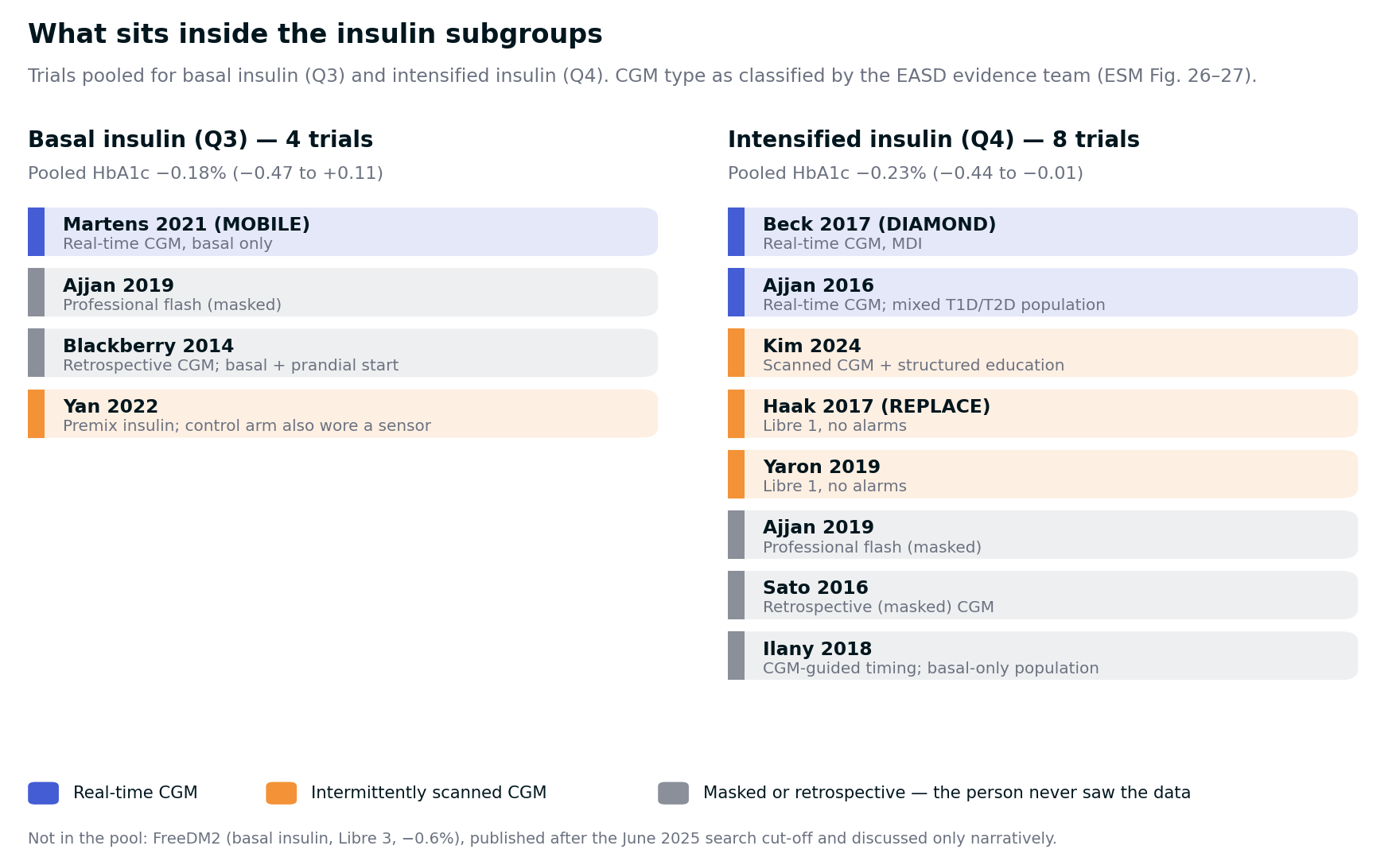
Figure 2. The trials behind the basal (Q3) and intensified (Q4) insulin results, by type of CGM used.
Several used masked CGM, where only the clinician saw the data afterwards.
Several used older sensors without alarms; FreeStyle Libre 1 was the most-studied device across the whole review.
Only one basal-insulin trial, MOBILE [3], tested real-time CGM in people on basal insulin alone. Its effect was −0.4%.
And some of the strongest real-time CGM trials in insulin-treated people are not in these subgroups at all.
The Danish Steno2tech trial (−0.8%) enrolled people on both basal and multiple daily insulin, so it only counts in the overall and real-time CGM analyses [13].
That is not a methodological error.
The panel asked about CGM in all its forms, and pooling was planned in advance.
But it means the pooled number describes the average CGM of the past fifteen years — not the sensor you prescribe today.
CGM does not lower glucose by itself. What people do with what they see, does.
What newer and real-world data add
The literature search closed in June 2025.
Several important studies have appeared since.
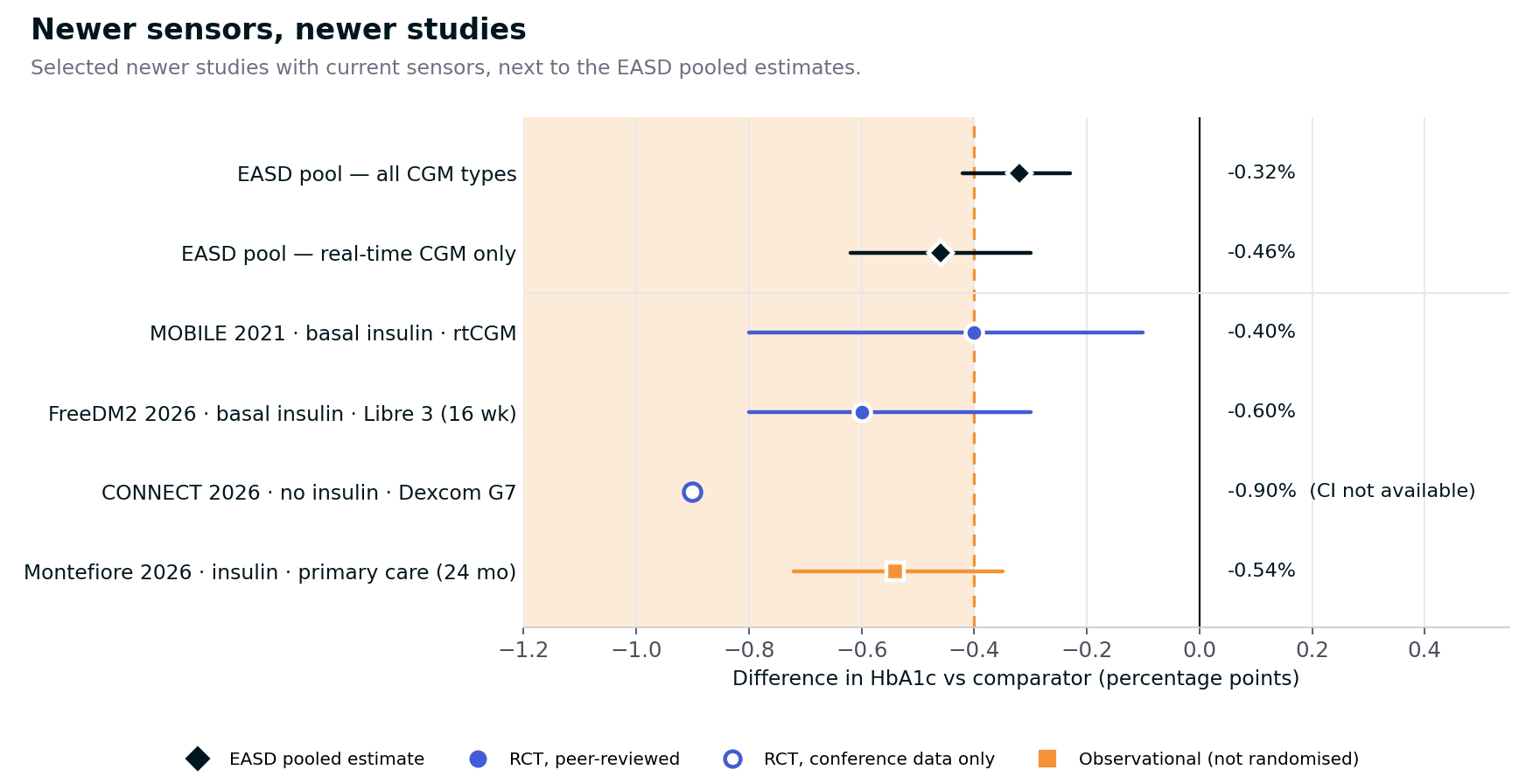
Figure 3. Newer or modern-sensor studies next to the EASD pooled estimates. Filled circles: peer-reviewed trials. Open circle: conference data only. Square: observational.
- FreeDM2 (UK, 2026) [4]. People on basal insulin plus a GLP-1 RA or SGLT2 inhibitor. FreeStyle Libre 3 lowered HbA1c 0.6% more than fingersticks after 16 weeks (95% CI −0.8 to −0.3), and 0.5% more after 32 weeks. Time in range rose by about 10 percentage points. Funded by Abbott.
- CONNECT (US, ADA 2026) [5]. People not on insulin, average HbA1c 8.8%. Dexcom G7 lowered HbA1c 0.9% more than routine care. The control group checked glucose about three times a week, many participants were undertreated, and full results are not yet published. Funded by Dexcom.
- A sobering counterpoint [6]: in people not on insulin, the benefit of six weeks of CGM had disappeared after 6 to 12 months. Short, one-off use does not seem to last.
Real-world studies answer a different question: not can it work, but what happens when a health system rolls it out?
- Andalusia, Spain (2026) [7]. After CGM was reimbursed for people with type 2 diabetes on multiple daily injections, hospitalisations for acute complications fell by about 65% and HbA1c by about 0.5%. A before-and-after comparison, in a European public health system.
- Montefiore, New York (2026) [8]. In 8,502 insulin-treated adults in primary care, CGM was associated with HbA1c 0.54% lower after two years and 18% fewer emergency visits.
- US claims data (2025) [9]. People who kept using CGM for most of the year saw HbA1c fall 1.5%, against 0.6% in matched non-users. Encouraging — but the most persistent users are also the most engaged. Funded by Roche.
Real-world effects are consistently larger than trial effects.
Some of that is real benefit in routine care.
Some is the design: people who start and keep using CGM differ from those who don’t.
And a reminder from our own backyard. In Belgian and German adults with type 1 diabetes, HbA1c fell by only 0.1–0.2% two years after starting CGM [10].
Nobody concludes that CGM failed in type 1 diabetes. Its value there lies in fewer severe hypos, fewer admissions and a better life.
If we judge CGM in insulin-treated type 2 diabetes on HbA1c alone, we are using a yardstick we would never accept in type 1.
EASD, ADA and the experts
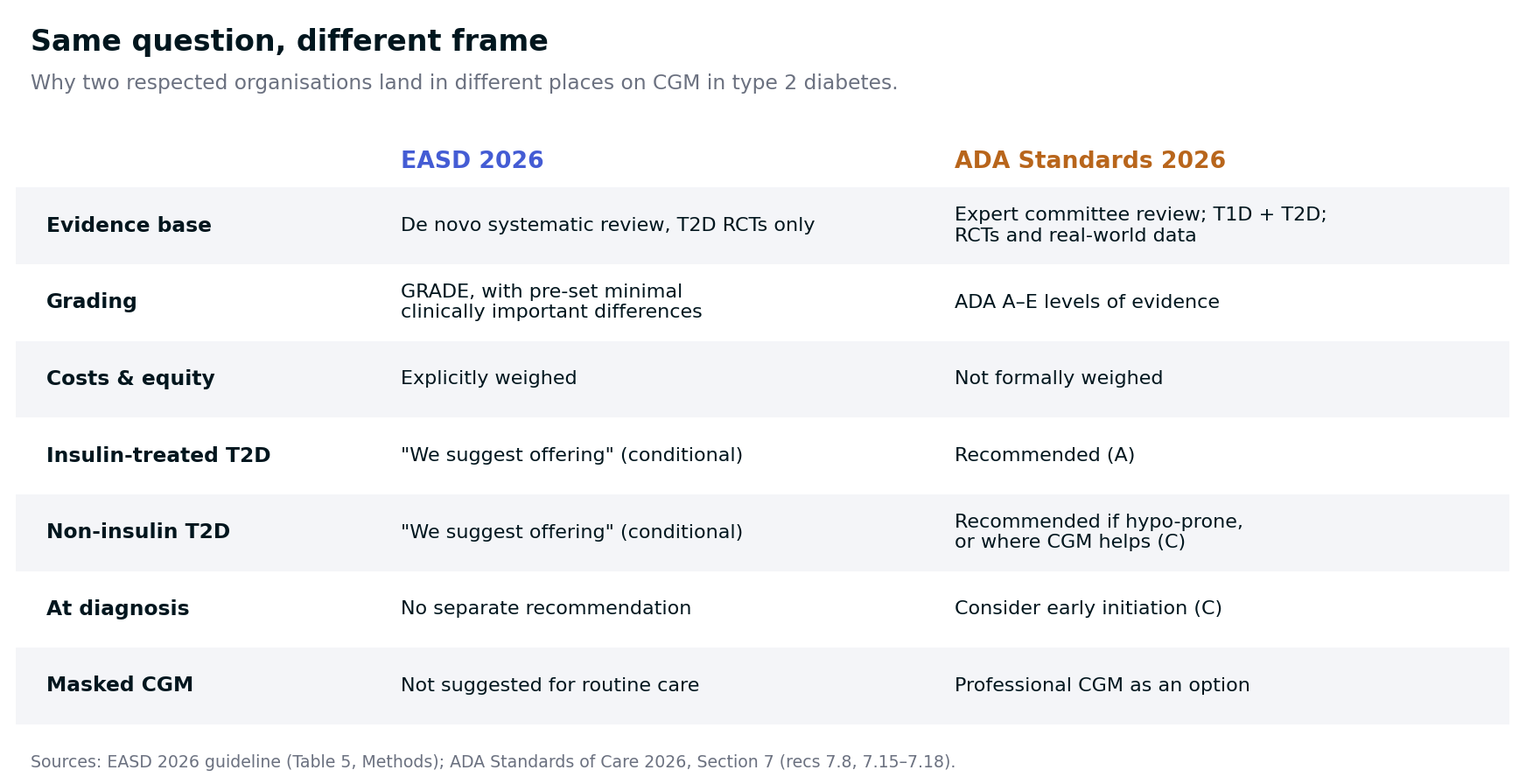
Figure 4. How the EASD guideline and the ADA Standards of Care 2026 approach CGM in type 2 diabetes.
The ADA recommends CGM for everyone on insulin (grade A) and suggests considering it early, even at diagnosis (grade C) [11].
The EASD suggests offering it to all, conditionally.
The main reasons for the difference:
- The ADA’s insulin recommendation covers type 1 and type 2 together; much of its strongest evidence comes from type 1. The EASD looked at type 2 only.
- The EASD set a threshold for clinical importance, and explicitly weighed cost and equity.
A 2024 expert Perspective went further than both [12].
It proposed CGM for all people with type 2 diabetes: two weeks at diagnosis, continuous use for anyone on insulin or other drugs that can cause hypoglycaemia, and periodic use at least every three months for everyone else.
Other organisations are just as clear:
- AACE (2026): “CGM is highly recommended to reach glycaemic goals in adults with diabetes” [14].
- Asia-Pacific consensus (2023): CGM should be considered in everyone with type 1 diabetes or type 2 diabetes on intensive insulin (grade A) [15].
- Diabetes Australia, with ADS and ADEA (2024): calls for subsidised CGM for people with all types of diabetes who need it, starting with insulin-treated type 2 diabetes [16].
None of these statements speaks of a “modest” HbA1c effect or low-certainty evidence.
That is partly because they are consensus and position statements, not GRADE guidelines: they draw on type 1 data, real-world studies and clinical experience, and they don’t test the type 2 trials against a pre-set threshold.
The EASD did exactly that — which is why its wording is more cautious, not because it disagrees on direction.
Many documents, one direction.
The EASD asks us to be precise about how far the evidence takes us today.
What this means in practice
|
Group |
What the evidence supports |
|---|---|
|
Multiple daily insulin injections |
Offer CGM. Judge it mainly on safety — fewer acute complications and admissions, less burden — not on HbA1c alone. |
|
Basal insulin |
Offer CGM. The newest trials are the most convincing here, especially when CGM supports active dose titration. |
|
No insulin |
A reasonable option with a clear purpose: to learn, to change behaviour, to guide a treatment change. Short one-off use does not seem to last. CGM does not replace optimising treatments with proven heart and kidney benefits. |
|
At diagnosis, for everyone |
Plausible, and proposed by experts — but not yet backed by type 2 trials. |
The question is no longer whether CGM belongs in type 2 diabetes.
It is whether the people who could benefit are offered one.
The part that is in our hands
What worries me most is not that CGM works less well than I hoped.
It is that too many people with type 2 diabetes are never offered one.
Many don’t know it is an option.
Many healthcare professionals still see CGM as a type 1 tool, or an insulin-only tool.
The EASD now says otherwise.
In my experience, a sensor largely explains itself.
Within days, people see what a meal, a walk or a bad night does to their glucose.
But nobody can learn from a sensor they never received.
A medicine only works if it is prescribed. The same is true for CGM.
Beyond reimbursement
In practice, care tends to follow reimbursement.
If a sensor is not reimbursed, it often isn’t mentioned at all.
That is understandable.
The EASD is candid that cost-effectiveness is still uncertain, except perhaps for people on insulin, and that health systems face real opportunity costs [1].
Many European countries are under financial pressure.
Reimbursement for everyone with type 2 diabetes is not around the corner.
But a conditional recommendation is, by definition, one where individual values and preferences matter.
Some people, fully informed, will judge a sensor worth paying for themselves — continuously, or for a few weeks at a time.
In most European countries, people can already buy a sensor without a prescription; in the US, dedicated over-the-counter sensors now exist [11].
So I would argue for this: mention CGM to every adult with type 2 diabetes, including when it is not reimbursed.
Explain what the evidence shows and what it doesn’t. Let the person decide.
I am aware this is partly a political choice.
Self-payment creates two-speed care, and the EASD itself warns that wider CGM use risks benefiting mainly affluent, digitally confident people [1].
That concern is real.
But staying silent does not make care more equal.
It only means that people who could afford it, and would choose it, never hear that the option exists.
Reimbursement decides who pays.
It should not decide who gets to hear about it.
The long-term answer remains better, fairer reimbursement, based on better evidence.
Until then, informing people honestly is the least we owe them.
My bias, and a thank you
You should know who is writing this. I believe in diabetes technology, and I built Diabetotech around it. Diabetotech offers around 60 accredited courses on diabetes technology; more than a dozen are free, including an introductory module on glucose sensors, and full access costs €95 a year.
I have multiple disclosures and Diabetotech has received educational grants from Abbott, Dexcom, i-SENS, Medtronic, Roche, ViCentra and VitalAire; sponsors have no input on course content.
And since I am being honest about my bias, let me be shameless about it too.
Our courses are built on exactly that conviction: that technology, used well, makes life with diabetes better. I won’t pretend otherwise.
The guideline panel started with a pre-specified question and method.
I started with a conviction and went looking for explanations, with the help of AI tools to search the literature.
Their approach is the more rigorous one.
I did not take part in the public consultation; this blog is not a critique of their work, but an attempt to read it well.
So thank you — to co-chairs Melanie Davies and Amanda Adler, to the clinical experts and methodologists on the panel, to Christian Petersen and Oliwia Kaczmarek for bringing lived experience into every stage, and to Aris Liakos and the evidence synthesis team in Thessaloniki.
This is careful, transparent work, funded without industry money.
That transparency is what made my own reading possible.
It is now up to all of us — clinicians, educators, industry and people with diabetes — to make sure CGM reaches the people who can benefit from it.
Kind regards,

Learn more about CGM — for free
Want to feel more confident offering CGM to people with type 2 diabetes?
Diabetotech offers free, accredited courses for healthcare professionals. No subscription needed.
- Master Modules: Glucose Sensors, Insulin Pumps, AID Systems
- Device-specific modules: Accu-Chek SmartGuide CGM, CareSens Air CGM, Kaleido insulin pump, DBLG2, Smart MDI System (InPen)
- Open-source AID systems: AndroidAPS, DIY Loop, iAPS, Trio
- AI in Diabetes Care: practical applications for healthcare professionals
New to CGM? Start with the Master Module: Glucose Sensors.
Start here: diabetotech.com
Want to go further? The full platform offers around 60 accredited courses, including modules on other CGM systems, pumps and AID, for €95 a year.
References
- Davies MJ, Adler AI, Liakos A, et al. EASD guideline on the use of continuous glucose monitoring for the management of type 2 diabetes. Draft for public consultation, July 2026. https://www.easd.org/guidelines/statements-guidelines/cgm-in-t2d/ [Add Diabetologia citation and DOI once published.]
- Liakos A, et al. (EASD Evidence Synthesis Team). Supplementary Material A: Evidence synthesis technical report; Supplementary Material C: GRADE evidence-to-decision tables. Published with the EASD draft guideline, July 2026. https://www.easd.org/guidelines/statements-guidelines/cgm-in-t2d/
- Martens T, Beck RW, Bailey R, et al. Effect of continuous glucose monitoring on glycemic control in patients with type 2 diabetes treated with basal insulin: a randomized clinical trial (MOBILE). JAMA 2021;325(22):2262–2272. https://jamanetwork.com/journals/jama/fullarticle/2780593
- Wilmot EG, Moore P, Sathyapalan T, et al. Continuous glucose monitoring versus self-monitoring of blood glucose in individuals with type 2 diabetes: a randomised, multicentre, open-label, superiority trial (FreeDM2). Lancet Diabetes Endocrinol 2026;14:463–474. https://www.thelancet.com/journals/landia/article/PIIS2213-8587(26)00076-8/fulltext
- Oser T, Beck RW, Martens T, et al. CGM for adults with type 2 diabetes not on insulin therapy: the CONNECT randomized controlled trial. Diabetes 2026;75(Suppl 1):1170-OR. Results presented at the ADA Scientific Sessions, June 2026. https://diabetesjournals.org/diabetes/article/75/Supplement_1/1170-OR/167182
- Zhang, et al. The upfront effectiveness of a 6-week continuous glucose monitoring intervention for non-insulin-using individuals with type 2 diabetes is no longer detectable at 6–12 months: an observational follow-up of a randomized trial cohort. Diabetes Obes Metab 2026. https://dom-pubs.onlinelibrary.wiley.com/doi/10.1111/dom.71048
- Martínez Brocca MA, et al. Implementation of intermittently scanned continuous glucose monitoring and changes in hospitalizations and health care costs in insulin-treated type 2 diabetes. Diabetes Care 2026;49(8):1442. https://diabetesjournals.org/care/article-abstract/49/8/1442/172100/Implementation-of-Intermittently-Scanned
- Milosavljevic J, et al. Primary care–initiated continuous glucose monitoring in adults with insulin-treated diabetes. JAMA Netw Open 2026. https://jamanetwork.com/journals/jamanetworkopen/fullarticle/2851138
- Hirsch IB, Garg SK, Repetto E, et al. Continuous glucose monitoring frequency and glycemic control in people with type 2 diabetes. JAMA Netw Open 2025;8(10):e2539278. https://jamanetwork.com/journals/jamanetworkopen/fullarticle/2840792
- Pazmino S, Schmid S, Steenackers N, et al. Weight and HbA1c trajectories following initiation of continuous glucose monitoring in adults with type 1 diabetes: a cohort study using group-based multi-trajectory analysis. Lancet Reg Health Eur 2026;69:101806. https://www.thelancet.com/journals/lanepe/article/PIIS2666-7762(26)00218-8/fulltext
- American Diabetes Association Professional Practice Committee for Diabetes. 7. Diabetes technology: Standards of Care in Diabetes—2026. Diabetes Care 2026;49(Suppl 1):S150–S165. https://diabetesjournals.org/care/article/49/Supplement_1/S150/163922/7-Diabetes-Technology-Standards-of-Care-in
- Ajjan RA, Battelino T, Cos X, et al. Continuous glucose monitoring for the routine care of type 2 diabetes mellitus. Nat Rev Endocrinol 2024. https://www.nature.com/articles/s41574-024-00973-1
- Lind N, Christensen MB, Hansen DL, Nørgaard K. Comparing continuous glucose monitoring and blood glucose monitoring in adults with inadequately controlled, insulin-treated type 2 diabetes (Steno2tech study): a 12-month, single-center, randomized controlled trial. Diabetes Care 2024;47(5):881. https://diabetesjournals.org/care/article/47/5/881/154335/Comparing-Continuous-Glucose-Monitoring-and-Blood
- American Association of Clinical Endocrinology. Consensus statement: algorithm for management of adults with type 2 diabetes – 2026 update. Endocr Pract 2026;32(4):473–518. https://www.endocrinepractice.org/article/S1530-891X(26)00022-4/fulltext
- Asia-Pacific consensus recommendations for application of continuous glucose monitoring in diabetes management. Diabetes Res Clin Pract 2023. https://www.diabetesresearchclinicalpractice.com/article/S0168-8227(23)00481-3/fulltext
- Diabetes Australia, in consultation with the Australian Diabetes Society, the Australian Diabetes Educators Association and JDRF Australia. Position statement: Equitable access to diabetes technology. 2024. https://www.diabetesaustralia.com.au/wp-content/uploads/2024-Diabetes-Australia-Position-Statement-Equitable-Access-to-Diabetes-Technology.pdf